
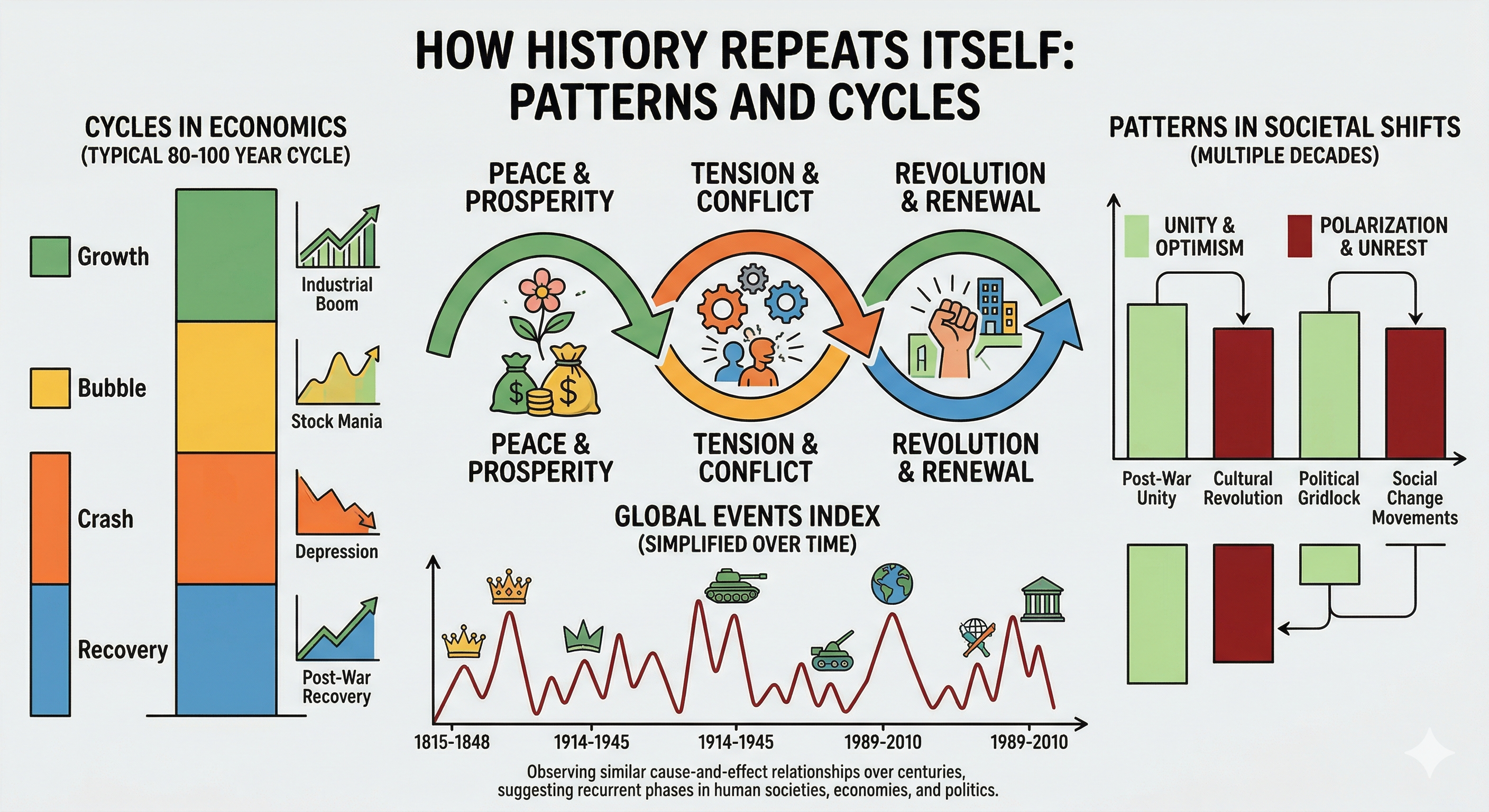
History sighs, repeats itself
In the backdrop of recent global events, it's worth discussing why we diversify, how to do it right, and why there are dozens of different investment holdings in your account(s).
Before I go too far, though, I'll ask you to visualise a recent account statement from Schwab, or the Springboard year-to-date summary (in your brain is fine, or pull out a copy if you will) . If you look at the holdings in your account(s) you'll see a whole lot of 'em. For some families it may exceed two dozen due to differing tax treatments in different accounts. Holy cow - why so many!? Well, the one word answer to that is “correlation”. Actually, it should be two words:
Lower Correlation
Different asset classes react differently in different economic and geopolitical environments. Our goal is to create a mix of investments that don't all move in lockstep. We don't want one stock, one industry, one economy, one interest rate, or any one factor to affect every dollar invested. We want (say it with me…) diversification! Put those eggs in different baskets, right? We've all heard that, but how does it work with investments?
Below is a chart of some of our major holdings. I didn't put every smaller asset class in the table as it would become too hard to read, and those asset classes would actually be show lower correlation to what we see here, so you'll still get the point.
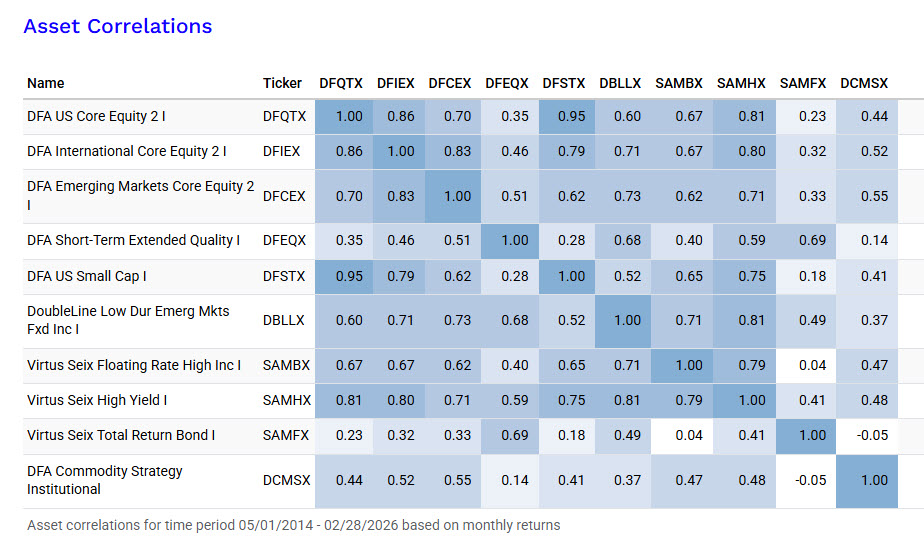
So, of the 11 asset classes I represented, this is the correlation factor that was calculated for the time betwen May 2014 and February 2026 (the period of time each fund has been in existence). The darker the square, the closer to 1.00, which is exact correlation (which is why you see the diagonal each fund compared to itself is 1.00).
The goal is to have a variance in shading. It's ok to have some dark as long as we also have some light. We even have a few under 25%, and even one that's negative!
This chart above is the correlation for the entire 12-ish year period. But there are shorter cycles within that period that are even more interesting, I think. For example, looking at the top two, it looks like US Core and International Core move pretty closely together at 0.86. But for different periods, the difference can be much more exaggerated:
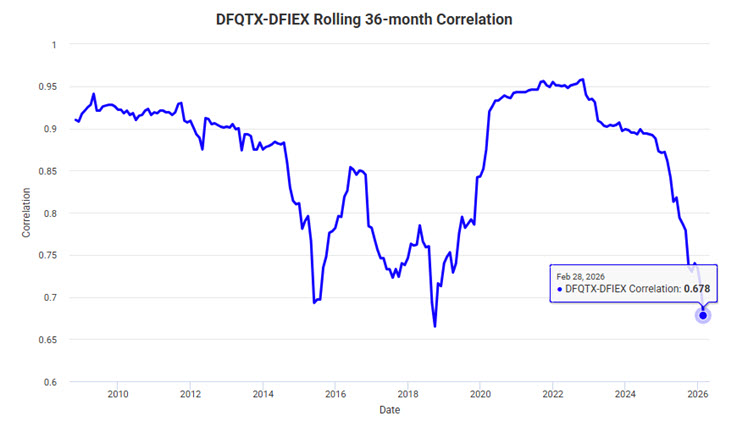
Looking at this chart, there are definitely some periods that show more separation in performance between the two, and you may have noticed this in the last few yearly reports.
Uncertainty IS the norm
Ok, I got the numbers out of the way and took a long time to get here, but the point is - there is no such thing as a “certain” market. Oh, all this uncertainty out there today! Well, uncertainty IS the historical norm. Back to the subject of the email, the current conflict in the Middle East (as an example) is not the first. History rhymes. (paraphrasing a quote attributed to Mark Twain).
So what do we do? We prepare as best as we can for unpredictable markets and we (say it with me…) diversify!
It's hard not to think of “the market” and extrapolate what your portfolio is doing based on what “the market” is doing based on what the people on TV are telling you. But what is “the market?" and does it even mean anything in the context of a diversified portfolio?
What is “the market?”
I expect that most investors think of the S&P 500 as a proxy for “the market.” But as it relates to a diversified portfolio, the discrepancies in returns between them can be dramatic.
For example, you may have heard of a period of time coined “the lost decade” where an investment in the S&P 500 on January 1, 2000 would have net you a whopping LOSS of .9 percent per year on average through the end of that decade. A diversifed 60/40 portfolio would have returned in the range of 6.5%/year (note: that seems a little low, but inflation clocked in at 2.5% for that period, so an inflation-adjusted return of 4% is maybe slightly lower than optimal for a financial plan, but well within the range of expected returns)
Of course, the stocks that comprise the “the market” of the S&P 500 are still present in your portfolio, but to a much lesser degree. In the three Core equity holdings every client has, there are nearly FIFTEEN THOUSAND stocks represented globally. And even then those stocks only comprise somewhere around 50-70% of the portfolios Springboard manages, with additional exposure to REITs, commodities, and bonds around the world. So although the S&P will have some bearing on the totality of your returns, there may well be other asset classes offsetting what the S&P is doing.
The point (finally)
The point is, most people reading this have decades of unknown, unpredictable events yet to be experienced. And as the world turns, periods of chaos and confusion don't usually equate to corporations being unable to produce goods and services to their customers (exception: toilet paper during a pandemic, apparently). In your future, there will be more surprises, more geopolitical stress and more unpredictable events. We have followed academic science to assemble a portfolio that seeks to be as consistent as possible over time to help you and your family reach your financial goals, knowing that the unknown will occur.
And always remember, only a portion of your portfolio is invested in stocks. A significant portion, and enough to provide cash flow for years, is not exposed to the volatility of the market.
The below URL will take you to a short article by Dr. Wes Crill with a chart at the end that shows what the markets have had to endure since 1970. It's a lot of lousy stuff but “the market” continues on because people still need goods and services and companies continue to serve their customers throughout. Hopefully this will give you some solace in times where things seem overwhelming. Certainly, take care of your well-being and do what you need as a human being to move through it, but remember that markets have been through some pretty awful events and still come through in the end. Here's the link to the web article: https://www.dimensional.com/us-en/insights/geopolitical-risk
A bonus point
One last point to remember is that pullbacks are absolutely normal and should be expected. The causes vary, but periods of negative returns are part of the investment experience. Our last three calendar years have been wonderful, and pretty much every asset class in 2025 did well above historical averages. So current geopolitical events notwithstanding, a pullback is not at all surprising. And a bad spell does not portend a bad year, either. You may recall an event that affect global markets starting in March 2020 which set off market sell-offs globally. It was a scary time. But a 60/40 portfolio ended the year over 12% higher than it started, DESPITE a global pandemic. So although it can feel scary in the moment, market drops are temporary. Another short article from Dr. Crill if you're interested. https://www.dimensional.com/us-en/insights/stop-drop-and-stay-the-course
-Charles